


The Einstein bill
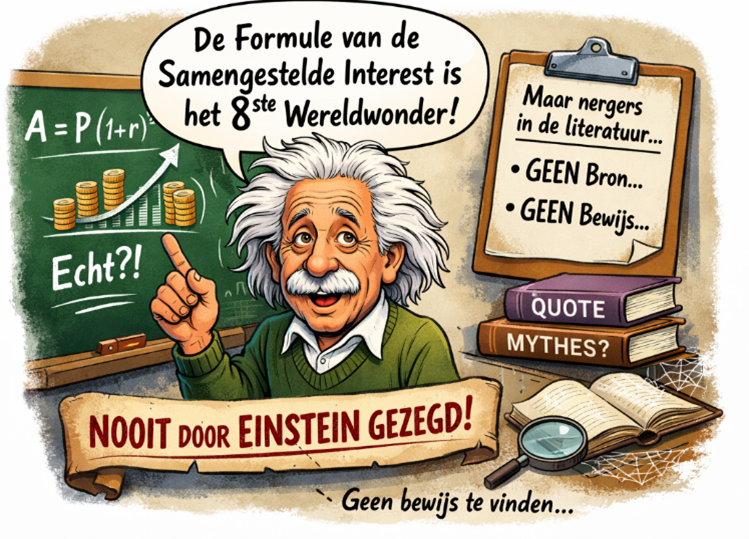
You have probably already heard of the Einstein account, the political proposal of the Liberal Party "Anders." Chairman Frederic De Gucht wants to encourage citizens to start investing in the stock market as early as possible and thus enable them to build up a nice capital in the long term. The message is to start as early as possible, because that way the 8th wonder of the world, compound interest, can work optimally. Many attribute this statement to Albert Einstein. However, there is no evidence in the literature that Albert Einstein ever said this, but it is often used in financial marketing.
At the end of 2025, €301.9 billion was parked in regulated savings accounts in our country. The Anders party wants to mobilize this enormous amount and encourage the population to participate in the stock market. It also wants to channel capital to European companies in order to strengthen the economy.
De Partij Anders gaf zelfs een praktisch voorbeeld om het voor het brede publiek begrijpelijk en tastbaarder te maken. Beleg je vanaf je geboorte elke maand 100 euro (1.200 euro per jaar) dan kan je bij een gemiddeld jaarrendement van 7% op je 67ste een kapitaal hebben bijeen gespaard van 1,6 miljoen euro. Op basis van historische rendementen lijkt ons dat niet onhaalbaar met een korf van beursgenoteerde Europese aandelen. Bovendien kan dat rendement nog opgekrikt worden als je jaarlijks 40% mag aftrekken van je belastingaangifte!
In itself, this is of course a very good idea. Instead of "parking" your money in savings accounts that cannot keep up with inflation and thus make the population poorer, investing in listed shares has historically yielded much higher returns in the long term. But of course, this requires you to take more risk. After all, you are buying a piece (share) of a company that takes risks to create value.
We can only recall two important laws in Belgium that have fundamentally stimulated and encouraged investment in listed shares: the Cooreman-De Clercq law of 1982 and its successor, the tax-advantaged third pillar pension savings scheme. All other laws in Belgium aimed to do the opposite, namely to tax investors more heavily. It is also striking that these higher taxes were always introduced when the Flemish liberals were in the national government.
The evolution of investment taxation

Dat de liberale Partij nu op het dieptepunt van het aantal kiezers (5,8% nationaal), een omslag maakt en beleggen op de beurs terug aantrekkelijker wil maken, lijkt dus een verstandige keuze. Deze stelselmatig verhoogde belastingen op kapitaal zal de liberalen heel wat kiezers hebben gekost. Frederic De Gucht moet iets doen om die verloren kiezers terug te winnen. De liberalen staan traditioneel voor minder belastingen, economische en individuele vrijheid én een overheid die zich focust op zijn kerntaken (zoals justitie, veiligheid en onderwijs). Het probleem is natuurlijk dat er weinig andere partijen zijn in België die het beleggen op de beurs willen aanmoedigen (integendeel). De vraag is dus of dit voorstel enige kans maakt op slagen. Bovendien moet de partij Anders kiezers winnen en eerst terug in de regering kunnen stappen.
The question is whether the government should be involved in organizing games of chance. In any case, gambling companies sell "air" or "dreams" in their advertising slogans. The following slogans from the National Lottery make this all too clear: "Millionaires wanted," "Become outrageously rich," "Play wherever and whenever you want," "You never win alone," "Together we make dreams come true," "Do whatever you want," and "With Joker+, every day is your lucky day."
Probability of losing the lottery: 99.99998772%
We would like to take a moment to consider the odds of winning and losing in the two most important lottery games offered by the National Lottery. The odds of winning the Lotto with six correct numbers are 1 in 8,145,060, or 0.00001228%. The probability of losing is inversely proportional, i.e. 99.99998772%. The odds of winning the jackpot in Euromillions are even smaller, namely 1 in 139,838,160 or 0.00000072%, so the odds of not winning are 99.99999928%. All statistics relating to the odds of winning are listed in the official rules of each game. However, it is likely that only a few people read these, and the marketing department of the National Lottery will understandably not include these odds of winning or losing in its advertising messages.
The National Lottery has just published its press release on the annual figures for 2025. In 2025, a record amount of €1.666 billion was wagered, 7.3% more than in 2024. The press release states: "€1.266 billion in 'winnings' was paid out." If our math is correct, for all players combined, that €1.666 billion is the total cost and €1.266 billion is the total revenue. So, all players combined lost €400 million in 2025. That amount will, of course, go to charity (after deduction of various costs, including operating costs and advertising).
In 2025, there were 323 million game moments at the National Lottery, with an average stake of €5.20 per game moment. There are 2,367,254 identified players in Belgium. On average, 2.4 million Belgians gamble €704 per year at the Belgian National Lottery.
Maar, vergis u niet. In België wordt er flink meer gegokt dat via onze eigen Nationale Loterij. Volgens statistieken van de Kansspelcommissie groeit de totale gokmarkt met 10% per jaar tussen 2019 en 2023, van 22,68 miljard euro naar 33,0 miljard euro. We zochten in het jaarverslag van 2024 gepubliceerd in oktober 2025 naar de statistieken over 2024. In de inhoudstabel zochten we naar Hoofdstuk 4 “de kansspelmarkt in cijfers”. Naar pagina 32 scrollend, lazen we tot onze grote ontsteltenis de volgende paragraaf:
Wanted: full-time employee
“At least one full-time employee of the Gaming Commission (KSC) secretariat is required to collect, check, and process financial data. As this position is currently vacant, it was not possible to provide reliable data in this report, even though the intention was to include the financial data for 2024 in this report. The KSC deeply regrets this situation, but as it has no autonomy in the recruitment process, it unfortunately does not have the necessary resources to remedy this. The financial data for the year 2024 will be published as soon as possible."
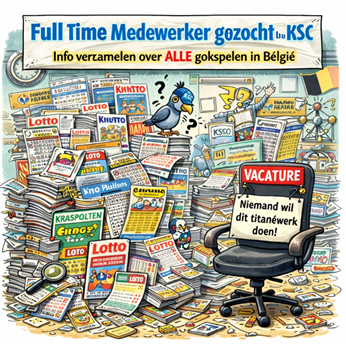
We inquired with the Gaming Commission. The answer we received was that the figures for 2024 are being finalized, but that the annual report still needs to be prepared afterwards. The publication of the figures for 2024 will therefore probably not be posted on the website until the spring of 2026. This is quite bizarre. The Gaming Commission is responsible for supervising gambling companies. However, it is struggling to recruit a single administrative assistant to collect the figures. Would the FSMA allow a listed company to publish its figures more than 15 months after the closing date?
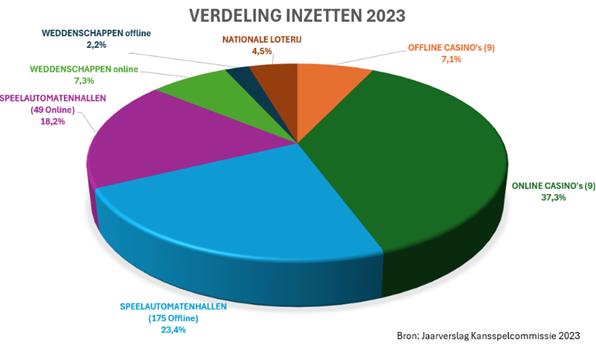
In the 2024 annual report of the National Lottery, we found this sentence: The National Lottery represents barely 4% of the total turnover of the entire gambling market. From this, we can deduce that the total stake in the Belgian gambling market (1.553 billion euros divided by 4%) amounted to 38.8 billion euros. We suspect that the Belgian gambling market exceeded €41 billion in 2025. In addition to the National Lottery, the major providers of games of chance are Gaming1, Napoleon Sports & Casino, Bingoal, and Betfirst. However, the majority (44.4%) of the total wagers in 2023 of 33 billion euros came from casinos (7.1% offline and 37.3% online). See distribution on pie chart:
Belgium has a population of approximately 11.825 million. A health survey conducted by Sciensano shows that 31.9% of the Belgian population will have participated in at least one game of chance (lottery, sports betting, casino, scratch cards) in 2023-2024. That is 3.77 million inhabitants. In other words, Belgians who gamble spend an average of almost €11,000 per year.
Another one bites the dust
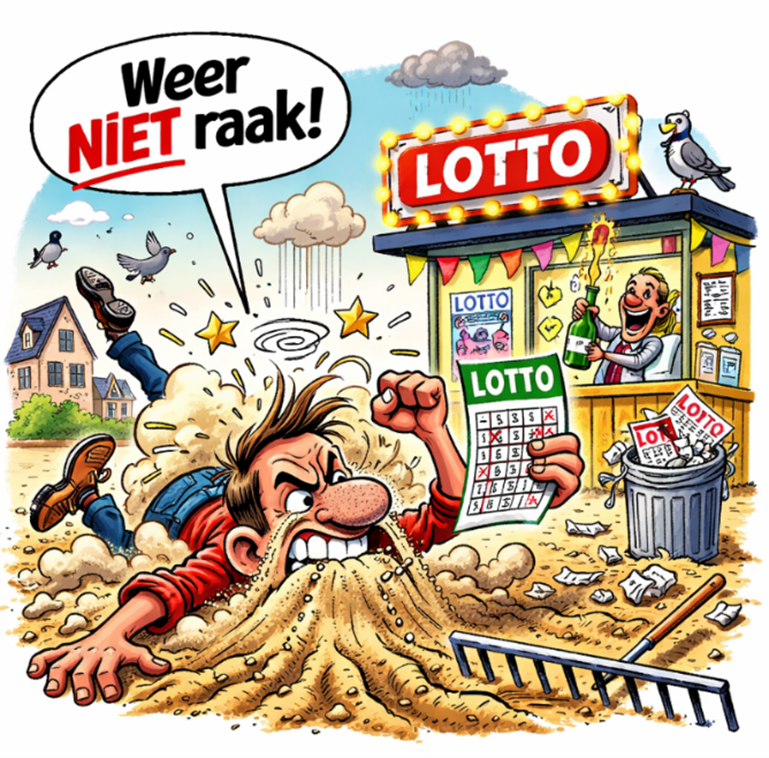
Only a few people take home the jackpot. For every winner, there are thousands of others who – figuratively speaking – bite the dust. “Another one bites the dust,” sang Freddy Mercury of Queen.
Investing is not the same as buying a lottery ticket. It is participating in entrepreneurship, innovation, and growth. And yes, there have been missteps in the stock market world. West Flanders undoubtedly remembers Lernout & Hauspie. The film Dust reopens old wounds. But one derailed story does not turn the stock market into a casino. The difference is fundamental: those who gamble play against the statistics. Those who invest benefit from the growth of companies. In the long term, it is not chance that wins, but the value creation of companies. They usually manage to pass on the increased costs (inflation) in their end products.
Perhaps the government should use the education system to teach everyone a little more about saving and investing. We can only encourage Frederic De Gucht's proposal to channel some of our hard-earned savings into the stock market.
With €41 billion in annual bets in the Belgian gambling industry, you could buy the four largest Belgian listed investment companies (GBL, D'Ieteren, Ackermans & van Haaren, and Sofina) alone. According to Value Square's fundamental value creation study, these companies delivered an average annual value creation of 7.24% over the period 2014-2024. Coincidence or not, this roughly corresponds to the interest rate that the Partij Anders party uses for its Einstein account.
Naast de 300 miljard euro op spaarboekjes, moet de overheid misschien ook proberen om die 41 miljard euro aan ‘jaarlijkse’ inzetten in de gokindustrie, trachten te mobiliseren om de koopkracht van de brede bevolking te verbeteren of tenminste in stand te houden in plaats van dromen te verkopen.
Auteur: Patrick Millecam
